Coursera: The Future of Education
Client: Coursera
Challenge: The Future of Education and Coursera’s Role in the Emerging Landscape
My role: Strategy Director
Agency: Material
November 2024
New York, New York
foresight is not prediction, but the ability to identify structural pressure before it goes mainstream
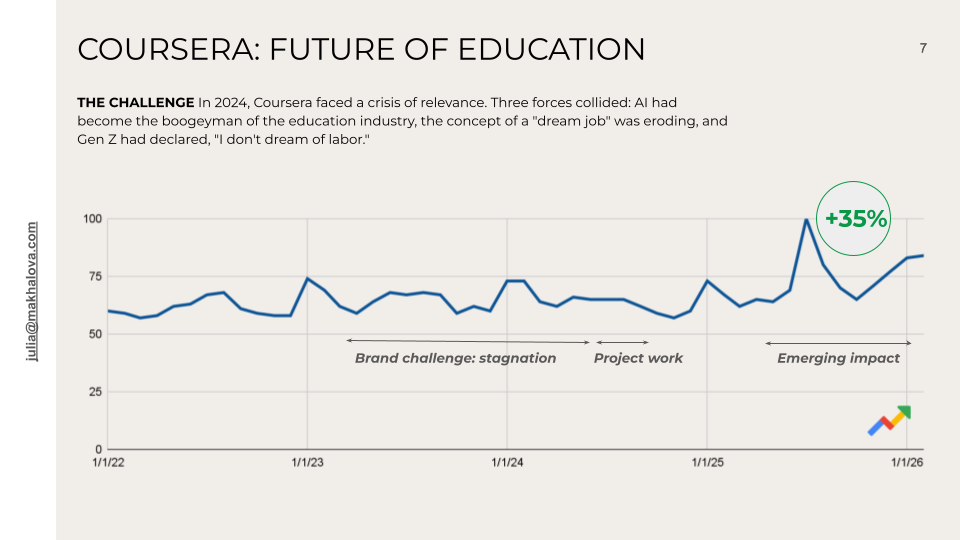
THE CHALLENGE In 2024, Coursera faced a crisis of relevance. Three forces collided: AI had become the boogeyman of the education industry, the concept of a "dream job" was eroding, and Gen Z had declared, "I don't dream of labor."
The leader of online education needed to answer an existential question: What type of educational partnerships should we offer when the traditional definition of work is collapsing?
APPROACH: The Fracture We Identified
CULTURAL SIGNAL MAPPING
Where do signals appear before institutions react?
We mapped the cultural edges: social media narratives, creator economy discussions, corporate research, and financial reports.
Patterns emerge where signals intersect.
STEP FRAMEWORK ANALYSIS
What are the forces reshaping the environment?
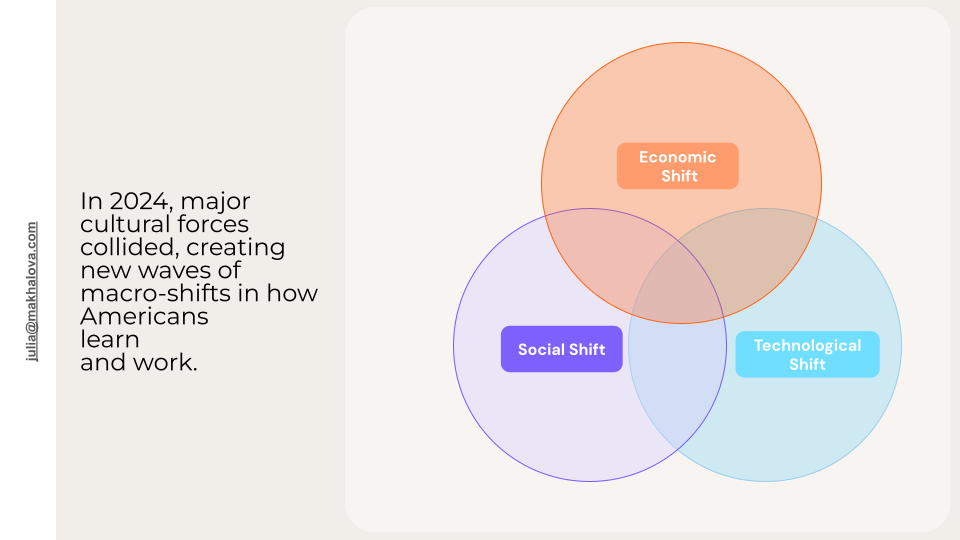
Signals are evaluated through the STEP framework: social, technological, economic, and political pressures.
Temporary noise is stripped from durable structural change.
DOMAIN IDENTIFICATION
Where will these pressures apply first?
In any professional domain, new skills, tools, or institutional partnerships become necessary.
The goal is to locate where change will surface earliest.
PARTNERSHIP STRATEGY
Who will help to accelerate the response?
We identified institutions, platforms, and partners at the center of emerging domains.
Partnership strategy converts cultural insight into institutional action.
QUANTITATIVE VALIDATION
Which opportunities to prioritize?
Survey research and platform data give scale to each signal.
Quantitative analysis helps determine where to move first.
MAPPING CULTURAL SIGNALS ACROSS EXTREMES
We mapped more than one hundred signals across two environments that rarely intersect: cultural discourse and institutional analysis.
At the cultural edge, TikTok burnout narratives showed successful millennials describing financial pressure, emotional exhaustion, and disillusionment with career success.
Creator-economy discourse reflected growing interest in independent income streams and smaller professional identities.
At the institutional level, research from sources such as Goldman Sachs and corporate workforce reports described increasing friction between generational expectations and workplace structures.
Signals from the extremes revealed five structural shifts underway.
AI will become a cultural boogeyman. Rather than a celebrated innovation, it will be increasingly perceived as a threat to employment.
Side-hustle culture will expand into the mainstream. Americans are building small businesses not to pursue ambition, but to secure a stable income outside traditional employment.
AI will democratize creative production. When anyone can generate content, the scarce skills become taste, curation, and direction.
Healthcare, education, and government will transform first as new tools alter professional roles.
Critical thinking will be the most valuable workplace skill. As organizations struggle to manage generational differences, demand for leadership, collaboration, and communication skills will surge.
Each shift corresponded to a strategic domain where Coursera could act through partnerships
AI and healthcare convergence pointed toward collaborations with medical institutions and healthcare training programs.
The rise of the side-hustle economy suggested partnerships with community colleges and creator-focused platforms offering practical business skills.
The democratization of creative production highlighted opportunities with design platforms and art schools focused on taste, branding, and AI-assisted creation.
The erosion of corporate aspiration suggested introducing certification pathways for skilled crafts and alternative professional identities.
Generational workplace friction pointed toward corporate transformation programs focused on leadership, collaboration, and interpersonal communication.
A quantitative survey, conducted with the analytics team, helped prioritize where Coursera should move first.
By 2026, many of these shifts had materialized
Coursera launched AI for Healthcare and AI for Health & Nursing programs through new institutional partnerships, securing early leadership in the AI-health education space.
Side-hustle culture accelerated across social platforms, and Coursera entered the space through partnerships with community colleges and creator platforms. The Skillshare collaboration introduced creator-driven education into the company’s ecosystem for the first time.
Creative education expanded through the Canva Essentials Professional Certificate, a thirteen-course program covering typography, branding, and AI-assisted design. It became the company’s first major creative partnership.
Corporate transformation programs expanded rapidly as organizations struggled with generational workplace friction. By 2026, critical thinking had risen to the most in-demand professional skill, driving large increases in enrollments across leadership and collaboration courses.
Major partnerships with Canva and Skillshare, alongside early movement in AI-health education, positioned Coursera ahead of competitors still defining their strategy.