The Coca-Cola Company: Multimillion-dollar growth opportunity. concept testing
Client: The Coca-Cola Company
Challenge: Concept Testing
My role: Strategy Director
Tools: Focus Groups, Affinity Mapping, Storytelling
Markets: US, UK, Japan, China
January 2024
New York, New York
concept testing
Challenge
Coca-Cola was looking to expand its RTD coffee offerings worldwide, based on high-growth-potential ideas. A qualitative deep dive identified opportunities in the US, UK, China, and Japan.
Project Philosophy: Concept testing of innovative ideas is a challenge. People say things they don’t actually mean. People want to be helpful and share their feedback, but don’t quite know why they like what they like.
Strong reactions are common. A concept can get a clear yes or no, but neither gives direction on why the idea isn’t working. It doesn’t tell you whether the issue is the product, the brand, or the way the idea is communicated.
Concept analysis is detective work. The task is to bypass the words people say, reveal their mental models, and then determine which concept resonates with the mental model and which doesn’t. Understanding the why behind people’s reactions to new ideas is the real problem.
My role: I led a team of international moderators and researchers to analyze concepts across regions and deliver the final recommendation: the idea worth a multimillion-dollar investment. The outcome was clear guidance on which ideas were value for money, and what needed more work.
From words to models
Instead of individually paced self-discovery exercises, we invited people into focus groups to disagree with one another. By watching the sources of their disagreements, we revealed what mattered to them.
In concept testing, the moderator’s role is to steer people away from illegible like-dislike answers and toward revealing their real behavior. We designed the conversation around three core questions.
How would you describe this to someone who had never seen it?
This question reveals clarity of the idea, relevance, and important features. People naturally express what they find most memorable.Who is this for?
This reveals the occasion, the growth audience, and the competition. Asking participants to imagine a potential fit inspires them to remember where they saw it before.When will you use this?
This exposes design relevance and shows how packaging can cue specific occasions and features. The question is less about the occasion itself and more about noticing significant symbols.
The real why behind the rejection and acceptance
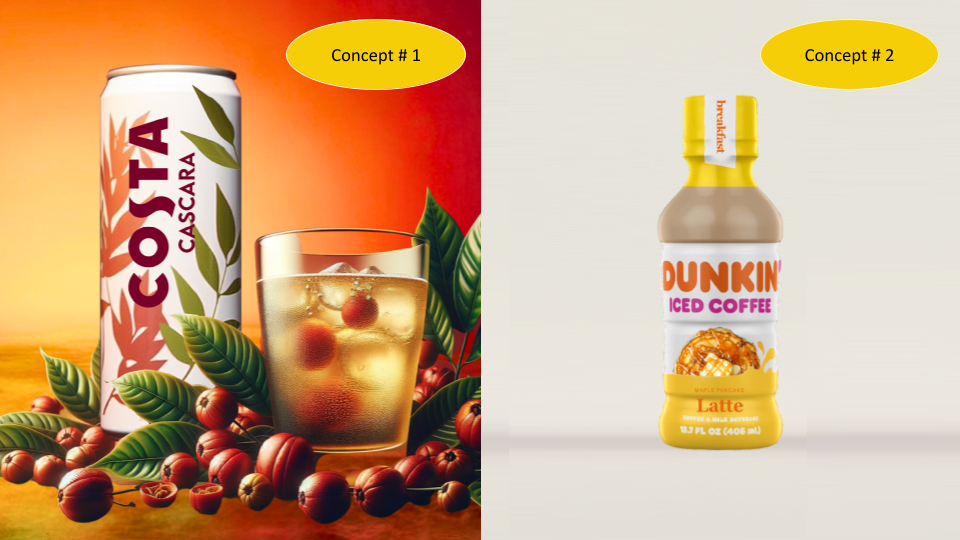
Coffee Cascara: a miscommunicated super-hero product.
One of the concepts was Coffee Cascara, a drink made from unroasted beans. The description met with an instant no: strong and clear, but ultimately uninformative.
When asked to describe the concept, the problem surfaced immediately. It was unclear what the drink was. Cascara was too novel. The transparent liquid looked fruity, not like coffee.
“I don’t know if it’s juice, I don’t know if it’s coffee. All of that is really unclear.”
Too different from existing offerings, the packaging lacked a direct suggestion of occasion—people didn’t know where this drink belonged in their life. Effervescent Cascara cued mocktails and alcohol alternatives, not typical coffee. While RTD coffee enthusiasts rejected the drink, the audience for Cascara may not be coffee drinkers at all, but rather mocktail aficionados.
When people described when they would drink it, they highlighted packaging symbols they relied on:
“The drink is transparent.”
“It looks cold.”
White packaging suggested an elegant, refreshing experience.
Ultimately, the rejection wasn't about the product. It was about trying to force it into the wrong category.
This reframed the entire opportunity: night occasions have never been explored by TCCC. Evening occasions emerged as a trailblazing opportunity.
Dunkin Breakfast: a low-hanging success story.
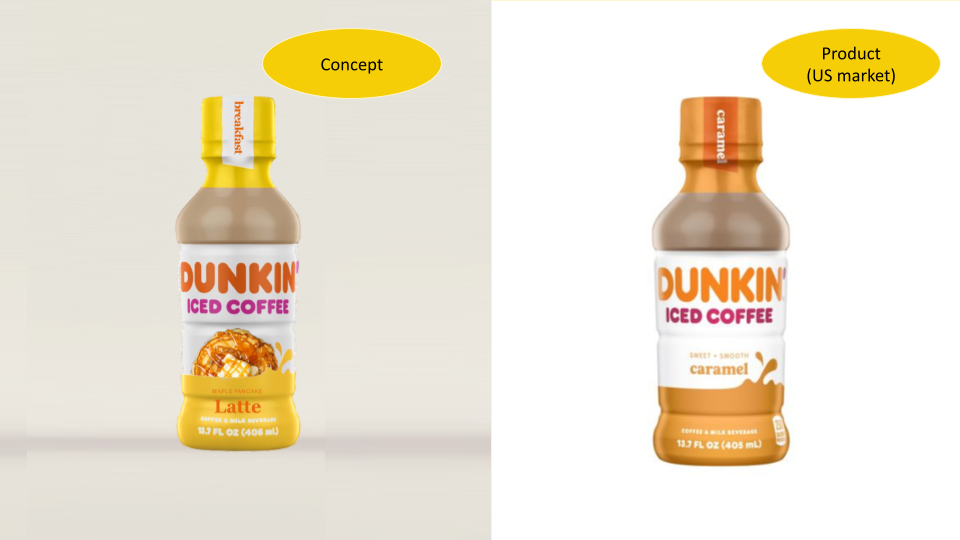
By contrast, Dunkin Breakfast RTD ended up as one of the most successful concepts. Many people said they don’t drink Dunkin coffee, yet the concept was a clear winner. It had the clearest and most organic positioning. It was exactly what people expected the Dunkin brand to do.
Product naming was one of the main reference points. Original names like “croissant” made it unclear whether ingredients were literally included: is the texture croissant-like? Dropping those names and returning to familiar conventions like “Butter Pecan” and “Caramel” resolved the issue. An unsweetened version helped people feel good about their choices in the morning.
Project impact
A clear understanding of the audience's needs has become one of the main growth engines of the Coca-Cola company globally.
While the core soft drink portfolio declined, coffee showed steady growth. The Dunkin portfolio expanded to include both healthier morning options and indulgent afternoon pick-me-ups. Cascara went back to the drawing board, repositioned as a night-time drink, opening a new space the company had never played in before.